
Summer 2026 is behind us. Record-breaking demand events, DOE emergency orders, and Maximum...
Gas Turbine Prices Up 195%. Here's What It Means for Your Maintenance
Gas Turbine Prices Up 195%. Here's What It Means for Your Maintenance
13:03
The number has been circulating since April, and it's worth sitting with: gas turbine prices are anticipated to reach $600/kW by the end of 2027, a 195% increase since 2019, according to Wood Mackenzie. For operators managing existing fleets, that figure isn't just a procurement headline. It fundamentally changes the economics of every maintenance, repair, and upgrade decision you'll make for the next several years.
When replacement costs nearly triple, the math on maintaining and investing in the installed fleet shifts dramatically. Assets that might have been candidates for retirement are now worth preserving. Upgrades that seemed expensive relative to replacement costs now look conservative. And deferred maintenance that once carried manageable risk now carries consequences that are harder to absorb.
The question isn't whether to invest in your existing turbines. The question is where to invest, and how to sequence those investments to capture the most value.
Why Replacement Is No Longer the Default
For most of the last decade, operators had a mental benchmark: if repair and upgrade costs approached a meaningful fraction of replacement cost, replacement became worth evaluating. That calculus worked when new turbines were available within a reasonable horizon at predictable prices.
Neither condition holds in 2026.
Global gas turbine orders currently stand at enough equipment to produce 110 GW of power, but available manufacturing capacity can produce only 60-70 GW. With order books sold through 2027, the window to secure turbines for projects targeting commercial operation before 2030 is closing fast. Equipment procurement timelines now define project schedules more than permitting or financing in many cases.
Turbine prices are highly volatile in 2026 and have been increasing by 2-3 times due to extraordinary demand from AI-driven hyperscalers and other market forces. When you factor in lead times, installation, balance-of-plant work, and permitting, a replacement turbine ordered today might not start generating revenue until 2030 or later.
For most operators, that's not a viable path to solving a capacity or reliability problem in the near term. Which means the installed fleet has to do the work, and investment decisions about those assets carry more weight than they ever have.
Your Existing Turbines Are Worth More Than You Think
When replacement cost rises sharply, so does the value of the asset you already have. A turbine you commissioned in 2008 that was once approaching the replacement-or-retire decision point now sits in very different territory. Its remaining useful life, its upgrade potential, and its current performance all represent value that didn't exist at the same scale two years ago.
A comprehensive EPRI audit of the U.S. gas turbine fleet found that the F-class fleet alone could gain a 34.1% improvement in continuous baseload operation through available upgrades, with an additional 400 MW of recoverable capacity across the fleet sitting untapped. That's capacity that exists today, in units that are already permitted, already staffed, and already connected to the grid. It simply needs investment to unlock.
Efficiency improvement investments that extend asset life by 10-15 years deliver return on investment within 3-5 years through cumulative fuel savings alone, making retrofit programs financially compelling for utilities and independent power producers. When you layer in the avoided cost of replacement at today's prices, the ROI case becomes stronger still.
The point isn't that every aging turbine deserves unlimited investment. It's that the threshold for justifying meaningful investment in existing assets has risen substantially alongside replacement costs, and many operators are still using outdated benchmarks when making those decisions.
Where the Investment Opportunity Is Greatest
Not every dollar spent on an existing turbine returns equal value. The highest-ROI investments in the current market share a common characteristic: they either add dispatchable capacity, extend the time between major outages, or reduce the risk of unplanned downtime during peak demand periods. Often, they do all three.
Advanced Gas Path Upgrades
Modern hot gas path components built from advanced single-crystal alloys with improved cooling geometries do more than maintain performance; they extend it. Replacing original-design stage 1 buckets and nozzles with upgraded hardware reduces thermal stress, lowers degradation rates, and can push hot gas path inspection intervals from 16,000 to 24,000 equivalent operating hours or beyond.
The economic impact is direct: fewer major outages over the operating life of the agreement, deferred parts replacement costs, and higher availability during the periods when the grid needs dispatchable capacity most. Hanwha Power's GTOP programs for 7F and 501F frames deliver documented output improvements of 6-10% alongside interval extension benefits—incremental capacity from assets you already own, at a fraction of the cost of new equipment that won't arrive for years.
Combustion System Modernization
Combustion hardware is often the first system to show the effects of changed operating profiles. Units that have shifted from baseload to cycling duty accumulate low-cycle fatigue on transition pieces, liners, and fuel nozzles faster than original inspection schedules anticipated. Combustion instability at low loads can force conservative operating limits that reduce dispatch flexibility precisely when flexibility has the most market value.
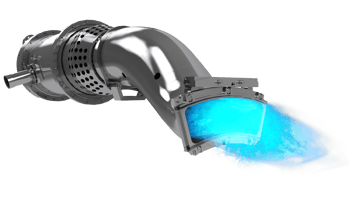
Upgrading to modern combustion systems addresses both problems simultaneously. Hanwha Power's FlameSheet™ combustion technology for F-class frames and LEC III Ultra Low Emission Combustion System for 7EA/B, 9E and 6B frames deliver single-digit NOx, improved turndown range, and fuel flexibility—allowing units to respond to dispatch signals across a wider load range while maintaining emissions compliance. For operators in markets with tight air quality requirements, that compliance headroom has direct commercial value.
Digital Monitoring and Controls
For every dollar invested in predictive maintenance, power plants recover $5 to $12 in avoided failures, extended asset life, and optimized maintenance scheduling. The reason the returns are so high is that predictive monitoring catches developing issues before they become forced outages, and forced outages during peak demand periods carry costs that dwarf any inspection or monitoring investment.
Combustion dynamics monitoring, exhaust temperature analysis, and integrated performance tracking give plant teams the visibility to make proactive decisions rather than reactive ones. Hanwha Power's AutoTune active combustion control system continuously optimizes fuel splits to maintain emissions compliance and combustion stability across changing ambient and load conditions, reducing the manual intervention burden on operations teams while protecting hardware from the dynamics-induced damage that shortens component life.
Component Repair and Life Extension
Not every investment requires new hardware. Advanced repair techniques for combustion liners, transition pieces, turbine buckets, and compressor blades can restore components to serviceable condition at a fraction of replacement cost, particularly relevant when even a 12-month life extension on major rotating equipment defers capital replacement costs that typically run $2 million to $15 million per unit.
Hanwha Power's in-house component repair capabilities for GE, Mitsubishi, and Siemens platforms combine precision manufacturing with engineering assessment to determine when repair is the right call versus replacement, and when upgraded replacement parts deliver lifecycle returns that justify the incremental cost.
How to Think About Investment Sequencing
With multiple upgrade and maintenance paths available, the question becomes which to prioritize and in what order. A few principles apply broadly:
Address reliability risks first. Components that are trending toward failure or operating beyond their recommended inspection interval are the highest-priority investments regardless of market conditions. An unplanned forced outage during a peak demand period is the most expensive event in the current grid environment, both in lost revenue and in the ripple effects on grid reliability.
Bundle upgrades into planned outage windows. The incremental cost of installing upgraded components during a planned combustion inspection or hot gas path outage is far lower than scheduling a dedicated upgrade outage. If you're opening the turbine anyway, evaluate whether modern components deliver enough lifecycle value to justify the incremental investment at that time.
Prioritize upgrades that extend inspection intervals. In a market where every outage has high opportunity cost, reducing the frequency of major outage events has compounding value. Advanced components that push HGP intervals from 16,000 to 24,000 EOH don't just reduce parts costs; they reduce the number of times per decade that your unit is offline during potential peak demand periods.
Evaluate the full plant, not just the gas turbine. A 2-3 percentage point improvement in turbine efficiency can yield millions of dollars in annual fuel savings for large power plants operating 24/7. But efficiency gains at the gas turbine can be constrained by HRSG, steam turbine, and balance-of-plant limitations that weren't designed for today's operating profiles. Hanwha Power's plant assessment services evaluate the full system to identify where investment delivers the most value and where upstream improvements are being bottlenecked downstream.
The Shift That's Already Underway
The market is already reflecting this logic. Wood Mackenzie forecasts that turbine orders will peak in 2026 as developers attempt to secure equipment for 63 GW of gas capacity additions through 2030, while data center electricity consumption is projected to increase 96% between 2026 and 2031, making AI and cloud infrastructure the fastest-growing source of new load on the U.S. grid. With new capacity constrained and demand accelerating, the value of the installed fleet isn't declining. It's compounding. EPRI's audit of the U.S. gas turbine fleet found that the F-class fleet alone holds an additional 400 MW of recoverable capacity through available upgrades, capacity that already exists on the grid, waiting for investment to unlock it.
Operators who treat this shift as a market signal and invest accordingly in the assets they already own are positioning themselves for the next five years of grid dynamics. Those who continue to defer maintenance or wait for replacement opportunities that may not materialize on the timelines they expect are compounding risk at exactly the wrong moment.
The 195% price increase in new turbines isn't just a procurement problem for developers chasing new capacity. It's a strategic signal for everyone managing an existing fleet: what you have is worth more than it used to be. Invest in it accordingly.
Evaluating where to invest in your existing gas turbine fleet? Hanwha Power's engineering team supports operators across GE, Siemens, and Mitsubishi frames with upgrade programs, component repair, digital monitoring, and plant assessment services designed to maximize the value and reliability of the installed base. Contact us to discuss your fleet's upgrade and lifecycle management opportunities.
References:
- Wood Mackenzie, "The US Gas Turbine Market: Navigating Manufacturing Scarcity and Demand Growth," April 2026
- EPRI / Gas Turbine World, "Unlocking Upgrade Value in the Gas Turbine Fleet," July 2026
- Wood Mackenzie, "Gas Turbine Market: Data Center Demand and Supply Constraints," April 2026
- Oxmaint, "Power Plant Predictive Maintenance ROI Guide," May 2026
- Natural Gas Intelligence, "Turbine Shortage Threatens Natural Gas-Fired Power Expansion," April 2026
- Utility Dive, "Gas Turbine Supply Crunch Set to Raise Prices 195% by 2027," April 2026